An IV set is a sterile medical device that delivers fluids, medications, and nutrients directly into a patient’s vein through a closed pathway from a fluid source to the vascular system. This guide covers IV set classification systems, patient-specific selection criteria, clinical and wellness applications, delivery mechanics, and essential safety protocols.
IV sets are classified by drip chamber size into macro drip sets (10, 15, or 20 drops per milliliter) and micro drip sets (60 drops per milliliter), with each calibration controlling infusion speed and volume precision for different patient needs.
Beyond chamber size, IV sets vary by design and function. Primary sets establish the main fluid line, secondary sets piggyback intermittent medications, blood transfusion sets integrate inline filters sized between 170 and 260 microns, and specialized options like vented, light-resistant, and volume-controlled sets each solve a specific clinical problem.
Choosing the right IV set depends on the patient population and prescribed therapy. Adult patients typically use macro drip sets for higher-volume delivery, while pediatric and neonatal patients require micro drip or burette sets that limit fluid availability and prevent overload. Blood products and chemotherapy agents each demand dedicated set configurations with precise filtration and light protection.
IV sets serve four core clinical functions: fluid replacement, medication delivery, nutritional support, and blood product administration. Each application pairs with specific tubing types, container compatibility requirements, and regulatory replacement intervals that govern safe use.
These same principles now extend beyond hospitals. Mobile IV therapy services use nurse-administered setups in homes and workplaces, applying identical safety standards (proper drip chamber fill levels, sterile technique, and correct set matching) to deliver professional-grade wellness infusions outside traditional clinical environments.
What Is an IV Set and How Does It Work?
An IV set is a medical device used to deliver fluids, nutrients, and medications directly into a patient’s vein. The sections below cover its main components and its fluid delivery mechanism.
What Are the Main Components of an IV Set?
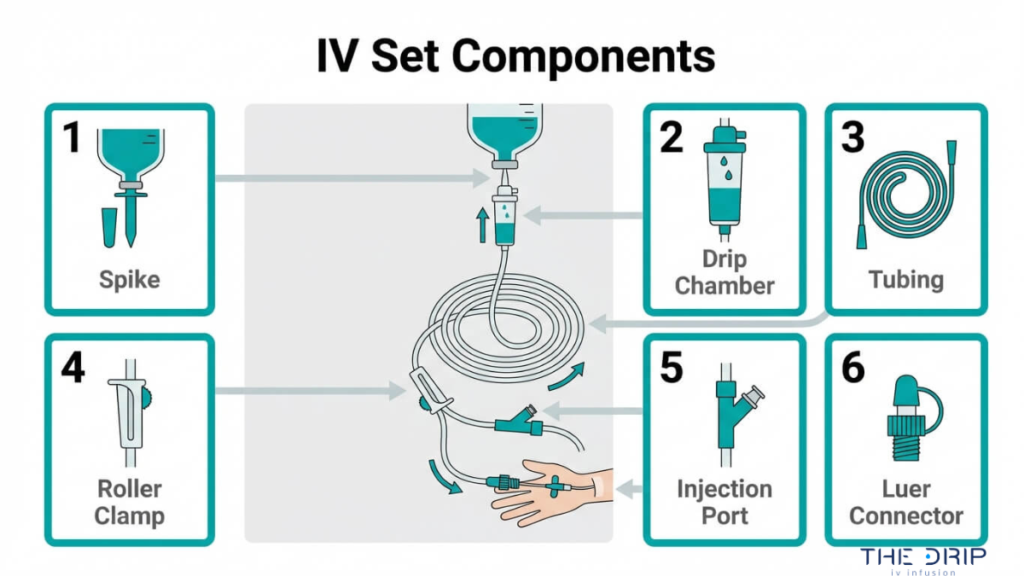
The main components of an IV set include:
- Spike: A rigid, pointed connector that pierces the port of an IV fluid container to establish a sterile fluid pathway.
- Drip chamber: A transparent reservoir that allows visual monitoring of the infusion rate and prevents air from entering the tubing.
- IV tubing: Flexible, sterile tubing that channels fluid from the drip chamber to the patient.
- Roller clamp: An adjustable mechanism that regulates or stops fluid flow through the tubing.
- Injection port: A self-sealing access point for administering secondary medications without disconnecting the line.
- Connector (Luer lock): A secure fitting that attaches the tubing to the IV catheter inserted in the patient’s vein.
Each component maintains a closed, sterile pathway from the fluid source to the patient’s vascular system. Understanding these parts helps clinicians and patients recognize how safe, controlled infusion is achieved.
How Does an IV Set Deliver Fluids Into the Body?
An IV set delivers fluids into the body through either gravity or mechanical pump pressure. Gravity-driven infusions rely on the height of the fluid column above the patient to generate downward pressure, pushing fluid through the tubing and into the vein. Peristaltic infusion pumps, by contrast, use mechanical force to deliver a specific volume at a predetermined rate, according to a 2024 review published in the National Center for Biotechnology Information.
Once the spike pierces the IV container, fluid flows into the drip chamber, where healthcare providers can visually count drops to confirm the correct rate. From there, the roller clamp fine-tunes flow before fluid reaches the catheter site. This simple yet precise system makes IV sets foundational to both hospital care and mobile wellness infusions.
What Are the Types of IV Sets Based on Drip Chamber Size?
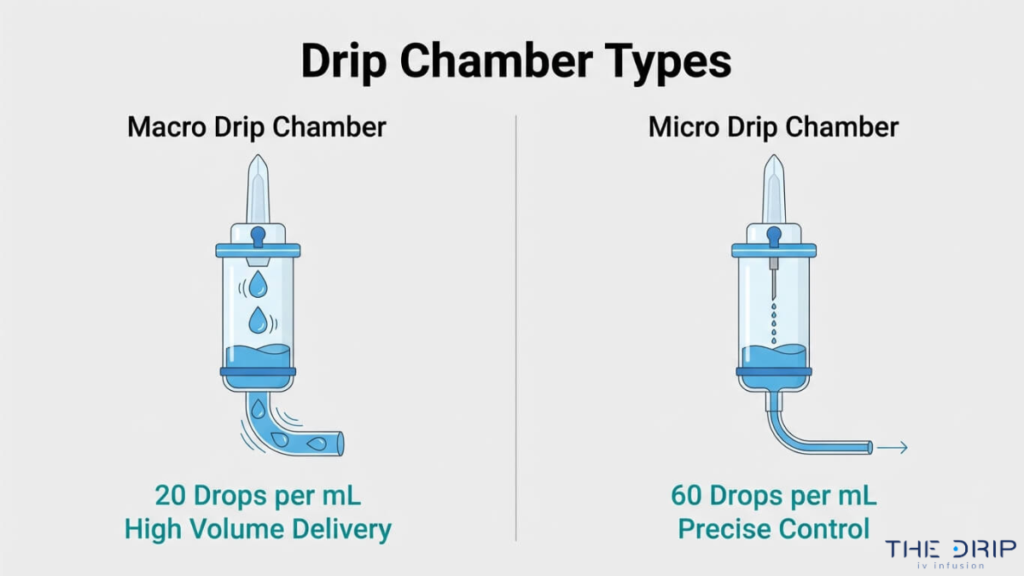
The types of IV sets based on drip chamber size are macro drip sets and micro drip sets. Each delivers a different number of drops per milliliter, which directly affects infusion speed and precision.
Macro Drip IV Set
A macro drip IV set delivers fluid in larger drops, with a drop factor of 10, 15, or 20 drops per milliliter. According to the National Library of Medicine, this contrasts with micro drip sets, which are standardized at 60 drops per milliliter. Clinicians select macro drip sets when patients need rapid fluid delivery, typically at rates exceeding 100 mL per hour. Common applications include emergency resuscitation, surgical fluid replacement, and large-volume hydration for adult patients. Because fewer drops are needed per milliliter, macro drip tubing moves higher volumes in less time. For most adult clinical scenarios requiring aggressive hydration, macro drip sets remain the default choice.
Micro Drip IV Set
A micro drip IV set delivers fluid at a standardized rate of 60 drops per milliliter, producing much smaller drops than macro drip tubing. This precision makes micro drip sets ideal for infusion rates below 100 mL per hour, where even slight volume variations could affect patient safety. Pediatric and neonatal patients benefit most from this controlled delivery, since their smaller body weight demands exact fluid dosing. Micro drip sets also pair well with infusion pumps for medications requiring tight rate control, such as vasopressors or analgesics. When volume accuracy matters more than speed, micro drip tubing is the safer, more reliable option.
Beyond drip chamber size, IV sets also vary by design features that determine their clinical function.
What Are the Types of IV Sets Based on Design and Function?
The types of IV sets based on design and function include primary, secondary, blood transfusion, vented, non-vented, dial-a-flow, volume-controlled, light-resistant, and pump-compatible sets. Each design serves a specific clinical purpose.
Primary IV Set
A primary IV set is the main infusion line that connects directly from the IV fluid container to the patient’s vascular access site. This set establishes the principal fluid pathway and typically includes a spike, drip chamber, roller clamp, and injection port. Primary IV sets deliver continuous infusions of crystalloids, medications, or nutritional solutions. Because they serve as the foundational delivery line, all other IV set types either replace or connect to a primary set. For most standard adult infusions, this is the first set selected.
Secondary IV Set
A secondary IV set is a shorter tubing line that connects to the primary set through an injection or Y-port. Clinicians use secondary sets to administer intermittent medications, such as antibiotics or supplemental electrolytes, without interrupting the primary infusion. The secondary bag hangs higher than the primary bag so gravity directs the secondary fluid first. Once that infusion finishes, the primary line resumes automatically. This piggyback configuration reduces the need for multiple venous access sites.
Blood Transfusion IV Set
A blood transfusion IV set is a specialized infusion line designed exclusively for delivering blood and blood products. According to Canadian Blood Services, blood administration sets require a standard filter with a pore size ranging from 170 to 260 microns to trap cell fragments, clots, or particulate matter that may develop during storage. The wider-bore tubing accommodates the viscosity of packed red blood cells and whole blood. Standard IV sets should never substitute for blood transfusion sets, since the integrated filter is essential for patient safety.
Vented IV Set
A vented IV set is an infusion line that features a small air vent in the spike to allow ambient air into the fluid container. Rigid glass bottles and some hard plastic containers require this air entry for fluid to flow out by gravity. Without the vent, a vacuum forms inside the bottle and stops the infusion. When using collapsible plastic bags, a vented set is unnecessary because the bag collapses as fluid exits. Selecting the wrong vent type for the container can halt fluid delivery entirely, making this distinction clinically important.
Non-Vented IV Set
A non-vented IV set is an infusion line without an air vent in the spike, designed for use with collapsible plastic IV bags. These bags compress naturally as fluid drains, eliminating the need for air replacement. Non-vented sets reduce the risk of airborne contamination entering the fluid pathway. Most modern hospital infusions use flexible plastic bags, making non-vented sets the more common choice in contemporary clinical practice. Pairing a non-vented set with a rigid glass bottle will prevent fluid flow.
Dial-a-Flow IV Set
A dial-a-flow IV set is an infusion line with a built-in flow regulator that allows clinicians to select a specific flow rate by turning a dial. The dial is calibrated in milliliters per hour, replacing manual roller clamp adjustments with a more precise, pre-set mechanism. These sets are particularly useful in settings where electronic infusion pumps are unavailable. While not as precise as programmable pumps, dial-a-flow sets offer a reliable middle ground between gravity-only control and full electronic regulation.
Volume-Controlled IV Set (Burette Set)
A volume-controlled IV set, commonly called a burette set, is an infusion line with a calibrated fluid chamber (burette) positioned between the IV bag and the drip chamber. This chamber limits the volume of fluid available for infusion at any given time. Clinicians fill the burette with a measured amount, preventing accidental delivery of excess fluid. The measured-volume approach makes the burette set one of the most practical safeguards against fluid overload in patients who require strict volume management.
Light-Resistant IV Set
A light-resistant IV set is an infusion line made from amber-colored or opaque tubing that shields photosensitive medications from degradation caused by ultraviolet or visible light exposure. Drugs such as nitroprusside, certain vitamins, and some chemotherapy agents lose potency when exposed to light during infusion. Standard clear tubing offers no such protection. Substituting a light-resistant set preserves medication efficacy throughout the entire delivery process.
Pump-Compatible IV Set
A pump-compatible IV set is an infusion line engineered to interface with electronic infusion pumps. The tubing segment that loads into the pump mechanism has specific dimensions and material properties matched to the pump’s peristaltic or cassette system. Using non-compatible tubing can cause inaccurate flow rates or pump alarms. These sets enable precise, programmable delivery measured in fractions of a milliliter per hour. Understanding each IV set’s design purpose ensures clinicians match the right equipment to each clinical scenario.
What Are the Types of IV Sets Based on Number of Ports?
The types of IV sets based on number of ports are single-port IV sets and multi-port (Y-type) IV sets. Each configuration determines how many fluid sources can connect to one IV line simultaneously.
Single-Port IV Set
A single-port IV set features one connection point between the IV container and the tubing. This design channels a single fluid source through the administration line to the patient’s vein. Single-port sets are standard for straightforward infusions where only one solution is needed, such as normal saline for hydration or a single medication drip. Because only one fluid pathway exists, the setup is simpler and reduces the risk of accidental flow interactions between incompatible solutions. For most routine infusions requiring just one fluid at a time, a single-port configuration is the most practical and cost-effective choice.
Multi-Port (Y-Type) IV Set
A multi-port (Y-type) IV set connects two or more fluid sources into a single IV line through a Y-shaped connector. This configuration allows clinicians to administer multiple solutions simultaneously or switch between fluids without disconnecting the tubing. Y-type sets are commonly used during blood transfusions, where normal saline must run alongside the blood product, and in surgical settings requiring rapid fluid changes. The Y-connector merges separate fluid pathways before the drip chamber, enabling controlled co-infusion. For patients needing complex multi-fluid protocols, Y-type sets reduce the need for additional venous access sites, which improves patient comfort and streamlines clinical workflow.
Understanding port configurations helps determine the right setup for each clinical scenario, which connects directly to broader patient selection criteria.
How Do You Choose the Right IV Set for a Patient?
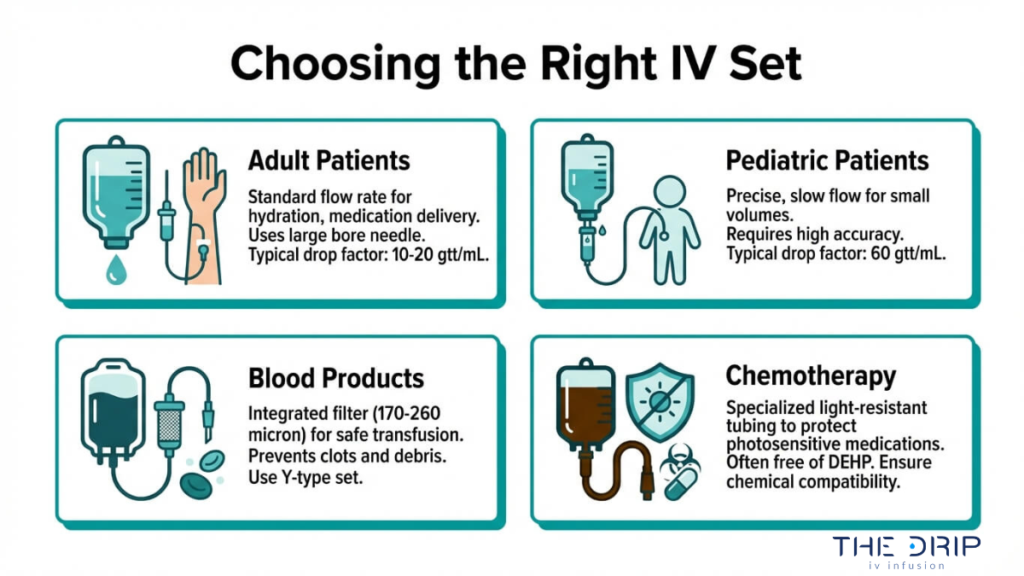
You choose the right IV set for a patient by matching the set type to the patient’s age, infusion rate, and the specific fluid or medication being administered. The sections below cover selection criteria for adults, pediatric patients, blood products, and chemotherapy.
What Type of IV Set Is Best for Adult Patients?
The best type of IV set for adult patients is typically a macrodrip set. Macrodrip sets deliver fluids at higher volumes, making them well suited for standard hydration, medication administration, and fluid resuscitation in adults. Most adult infusions require rates above 100 mL/hr, where macrodrip tubing provides efficient flow without excessive drop counting. For slower infusions or precise dosing, a secondary microdrip set or pump-compatible set may be paired with the primary line. Clinicians should also consider whether a vented or non-vented set is needed based on the fluid container type. Matching the IV set to the prescribed therapy prevents dosing errors and supports safe, effective delivery.
What Type of IV Set Is Used for Pediatric Patients?
The type of IV set used for pediatric patients is a microdrip set or a volume-controlled burette set. Microdrip sets are indicated for infusion rates less than 100 mL/hr or for pediatric and neonatal patients requiring precise volume control, according to Simple Nursing. Because children have smaller blood volumes and lower fluid tolerances, even minor miscalculations can cause harm.
Burette sets add another layer of safety by limiting the amount of fluid available for infusion at any given time. This design prevents accidental fluid overload. In practice, pairing a microdrip set with an infusion pump offers the highest accuracy for pediatric dosing. For any provider working with young patients, prioritizing volume-controlled delivery is non-negotiable.
What Type of IV Set Is Recommended for Blood Products?
The type of IV set recommended for blood products is a blood administration set with an in-line filter. This specialized filter features a pore size ranging from 170 to 260 microns, which traps cell fragments, clots, and particulate matter that develop during storage. Standard IV sets lack this filtration capability, making them unsafe for transfusions.
Blood administration sets also use larger-bore tubing to accommodate the viscosity of packed red blood cells and whole blood. Multi-port Y-type configurations allow simultaneous saline flushing during transfusion. Using the correct blood set reduces the risk of transfusion reactions and ensures the patient receives a clean, filtered product.
What Type of IV Set Is Used for Chemotherapy?
The type of IV set used for chemotherapy is a pump-compatible, light-resistant IV set designed specifically for cytotoxic drug delivery. Many chemotherapy agents are photosensitive, so amber-colored or opaque tubing prevents degradation from ultraviolet or visible light exposure. Pump compatibility ensures precise volumetric dosing, which is critical given the narrow therapeutic windows of most chemotherapy drugs.
Luer-lock connections are standard on chemotherapy IV sets to prevent accidental disconnection and hazardous drug exposure. Closed-system transfer devices may also integrate with the set to protect healthcare workers. Selecting the right chemotherapy IV set safeguards both the drug’s efficacy and the safety of everyone involved in its administration.
With the right IV set matched to each patient scenario, understanding common clinical applications adds further context to how these sets perform in practice.
What Are the Common Uses of IV Sets in Medical Settings?
The common uses of IV sets in medical settings include fluid replacement, medication administration, nutritional support, and blood product delivery. Each application requires specific IV set configurations.
How Are IV Sets Used for Fluid Replacement and Rehydration?
IV sets are used for fluid replacement and rehydration by delivering crystalloid or electrolyte solutions directly into a patient’s vein, bypassing the gastrointestinal tract for immediate absorption. The choice between vented and non-vented sets depends on the fluid container. Vented IV sets feature a small air vent in the spike that allows ambient air entry for fluid flow from rigid glass or plastic bottles, while non-vented sets pair with collapsible plastic bags that compress as fluid drains. Matching the correct set type to the container prevents flow interruption. For most clinical rehydration scenarios, selecting the appropriate set ensures consistent, uninterrupted delivery at the prescribed rate.
How Are IV Sets Used for Medication Administration?
IV sets are used for medication administration by creating a sterile pathway that delivers drugs in fluid form directly into a patient’s vascular system. According to CIA Medical, an IV administration set is a medical device designed to deliver nutrients and medications from a fluid source to the patient’s vein, optimizing both speed and bioavailability.
Certain medications require specialized tubing. Light-resistant IV sets, which feature amber-colored or opaque tubing, protect photosensitive drugs from degradation caused by ultraviolet or visible light exposure. This specialized design is essential for medications like nitroprusside and certain chemotherapy agents, where light exposure would reduce therapeutic efficacy. Proper set selection directly affects drug stability and patient outcomes.
How Are IV Sets Used for Nutritional Support?
IV sets are used for nutritional support by delivering total parenteral nutrition (TPN) or partial parenteral nutrition solutions containing amino acids, dextrose, lipids, vitamins, and electrolytes. Because TPN formulations are nutrient-dense and often lipid-based, they typically require dedicated IV tubing to prevent contamination and ensure compatibility. Filtered sets help remove particulate matter from complex nutritional solutions. Clinicians generally avoid running other medications through the same line to maintain solution integrity. This targeted approach sustains patients who cannot absorb adequate nutrition through oral or enteral routes.
How Are IV Sets Used for Blood and Blood Product Delivery?
IV sets are used for blood and blood product delivery by incorporating specialized inline filters that trap cellular debris. According to Canadian Blood Services, blood administration sets require a standard filter with a pore size ranging from 170 to 260 microns to capture fragments of cells, clots, or particulate matter that develop during storage.
Tubing replacement intervals also follow strict protocols. CDC guidelines recommend replacing administration sets for continuous infusions (other than blood, blood products, or fat emulsions) no more frequently than every 96 hours, but at least every 7 days. Blood-specific tubing, however, is typically changed after every unit or every four hours. These precise filter specifications and replacement schedules make blood delivery one of the most regulation-driven applications of IV sets, requiring careful attention from clinical staff.
With clinical applications established, understanding the differences between gravity and pump IV sets further refines proper set selection.
What Is the Difference Between Gravity IV Sets and Pump IV Sets?
The difference between gravity IV sets and pump IV sets lies in how each system controls fluid delivery. Gravity sets use hydrostatic pressure, while pump sets use mechanical force for precise volume control.
Gravity IV sets rely on the height of the fluid container above the patient to generate downward pressure that moves fluid through the tubing. Clinicians adjust the roller clamp manually to regulate flow, calculating drip rates using the standard formula: (Total Volume in mL × Drop Factor) ÷ Time in minutes. This approach works well for routine hydration and stable adult patients, though flow rates can shift with patient movement or changes in container height.
Pump IV sets connect to electronic infusion pumps that use peristaltic mechanisms to deliver a specific volume at a predetermined rate. According to CIA Medical, pump-compatible IV sets pair with infusion devices that eliminate the variability inherent in gravity-dependent delivery. These systems excel when dosing precision is critical, particularly in pediatric settings where medications like IV fluids and analgesics are more frequently involved in errors.
Key differences include:
- Flow control: Gravity sets use manual roller clamp adjustment; pump sets use programmable electronic regulation.
- Accuracy: Pump sets deliver exact volumes per hour, while gravity sets require frequent manual monitoring.
- Cost: Gravity sets are simpler and less expensive; pump sets require dedicated infusion pump hardware.
- Clinical indication: Gravity sets suit straightforward fluid replacement; pump sets are preferred for high-risk medications, pediatric patients, and critical care.
For most wellness IV sessions, gravity-based delivery provides reliable, consistent hydration without the complexity of pump systems. Understanding which system fits the clinical scenario ensures both safety and efficiency in any IV administration setting.
How Do IV Drip Rates Vary Between IV Set Types?
IV drip rates vary between IV set types based on the drop factor assigned to each set’s drip chamber. Macro drip sets and micro drip sets produce different drop volumes, which directly determines how quickly fluid reaches the patient.
The drop factor is the number of drops required to deliver one milliliter of fluid. Macro drip IV sets deliver 10, 15, or 20 drops per milliliter, making them suitable for rapid, high-volume infusions. Micro drip IV sets are standardized at 60 drops per milliliter, producing much smaller drops for precise, slow-rate delivery.
According to the British Columbia Institute of Technology, the drip rate formula for gravity infusions is calculated as: (Total Volume in mL × Drop Factor in gtts/mL) ÷ Time in minutes = Drops per minute (gtts/min).
This formula shows why set type matters so much. A 1,000 mL bag infused over 8 hours through a 15 gtts/mL macro drip set yields approximately 31 drops per minute, while the same bag through a 60 gtts/mL micro drip set requires roughly 125 drops per minute. The set selection changes the clinical workflow entirely.
Key drip rate differences by IV set type include:
- Macro drip sets (10, 15, or 20 gtts/mL) produce larger drops and are generally used when the infusion rate exceeds 100 mL/hr.
- Micro drip sets (60 gtts/mL) produce smaller drops and are indicated for rates below 100 mL/hr, particularly for pediatric and neonatal patients requiring precise volume control.
- Pump-compatible IV sets bypass manual drop counting entirely, using mechanical force to deliver a specific volume at a predetermined rate regardless of drop factor.
For most adult fluid resuscitation scenarios, a macro drip set paired with gravity delivery provides adequate rate control. Pediatric cases and medication infusions demanding tight volume accuracy, however, benefit significantly from micro drip sets or pump-driven systems. Choosing the correct drip rate setup is one of the most practical decisions clinicians make before starting any infusion, and understanding safety protocols ensures that choice remains effective throughout treatment.
What Safety Precautions Should Be Followed When Using IV Sets?
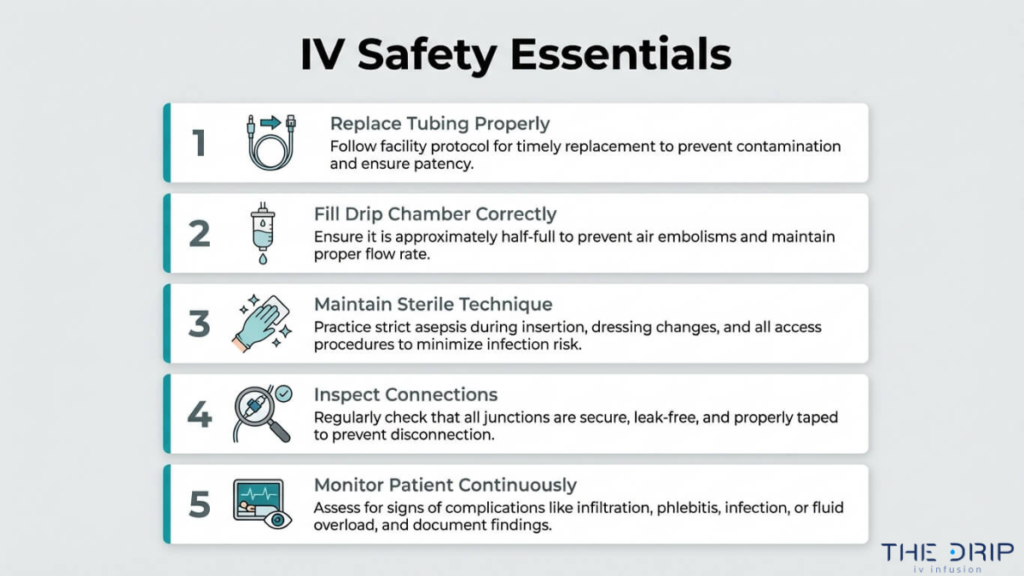
The safety precautions that should be followed when using IV sets include proper tubing replacement intervals, correct drip chamber filling, sterile technique, and careful line inspection. These measures reduce infection risk, prevent complications, and ensure accurate fluid delivery.
Key safety precautions for IV set use include:
- Replace administration sets at appropriate intervals. According to CDC guidelines, administration sets used for continuous infusions (excluding blood, blood products, or fat emulsions) should be replaced no more frequently than every 96 hours, but at least every 7 days.
- Fill the drip chamber correctly. The drip chamber should be filled to at least one-third or one-half of its capacity before starting an infusion, ensuring no air enters the tubing during the process.
- Maintain strict aseptic technique. All connections between IV tubing, fluid containers, and access sites must remain sterile throughout the infusion.
- Inspect tubing and connections before each use. Check for cracks, leaks, or particulate matter in the fluid line before initiating flow.
- Verify compatibility between the IV set type and the prescribed therapy. Blood products require filtered sets, photosensitive medications need light-resistant tubing, and pediatric patients need volume-controlled or micro-drip sets.
- Monitor the patient continuously during infusion. Watch for signs of infiltration, phlebitis, or flow rate changes that may indicate a problem with the IV set or access site.
Once a medication enters the vein, the action cannot be reversed. This reality makes proper preparation, accurate dosage calculation, and safe administration practices essential for every infusion. For clinicians and wellness providers alike, treating every IV set connection as a critical safety checkpoint is the most effective way to protect patients.
How Are IV Sets Used Beyond Hospital Settings for Wellness?
IV sets are increasingly used beyond hospital settings for wellness through mobile and home-based infusion services. The sections below cover nurse-administered home infusions and key takeaways about IV set types.
Can Mobile IV Therapy From The Drip IV Infusion Provide Nurse-Administered Infusions at Home?
Yes, mobile IV therapy from The Drip IV Infusion can provide nurse-administered infusions at home. Founded in Fall 2022 by professionals with decades of experience in nursing and emergency medicine, The Drip IV Infusion delivers personalized IV cocktails directly to clients in their homes or workplaces across Arizona.
This growing model reflects a broader industry shift. According to a 2025 Towards Healthcare report, the U.S. home infusion therapy market is expected to expand from USD 19.56 billion in 2025 to USD 39.57 billion by 2035, reflecting a CAGR of 7.3%. The same safety principles that govern clinical infusions apply in the home setting; nurses monitor drip chambers visually to confirm proper flow and fill chambers to at least one-third capacity to maintain safe fluid delivery.
For anyone exploring the types of IV sets discussed throughout this article, The Drip IV Infusion puts that knowledge into practice with convenient, professional care.
What Are the Key Takeaways About Types of IV Sets and Their Uses?
The key takeaways about types of IV sets and their uses center on matching the right set to the patient, fluid, and clinical scenario. The most important points include:
- IV sets are classified by drip chamber size (macro drip and micro drip), design and function (vented, non-vented, blood transfusion, light-resistant, volume-controlled), and number of ports (single-port and multi-port).
- Macro drip sets suit high-volume adult infusions, while micro drip sets provide the precision required for pediatric and neonatal patients.
- Specialty sets, such as blood transfusion sets with 170 to 260 micron filters and light-resistant sets for photosensitive medications, address specific clinical safety requirements.
- Gravity-driven and pump-compatible IV sets each serve distinct purposes depending on whether manual monitoring or programmable delivery is needed.
- Proper safety practices, including correct drip chamber fill levels and adherence to tubing replacement guidelines, apply equally in hospitals and home settings.
Understanding these distinctions helps patients and caregivers make informed decisions, whether in a clinical environment or through services like The Drip IV Infusion.