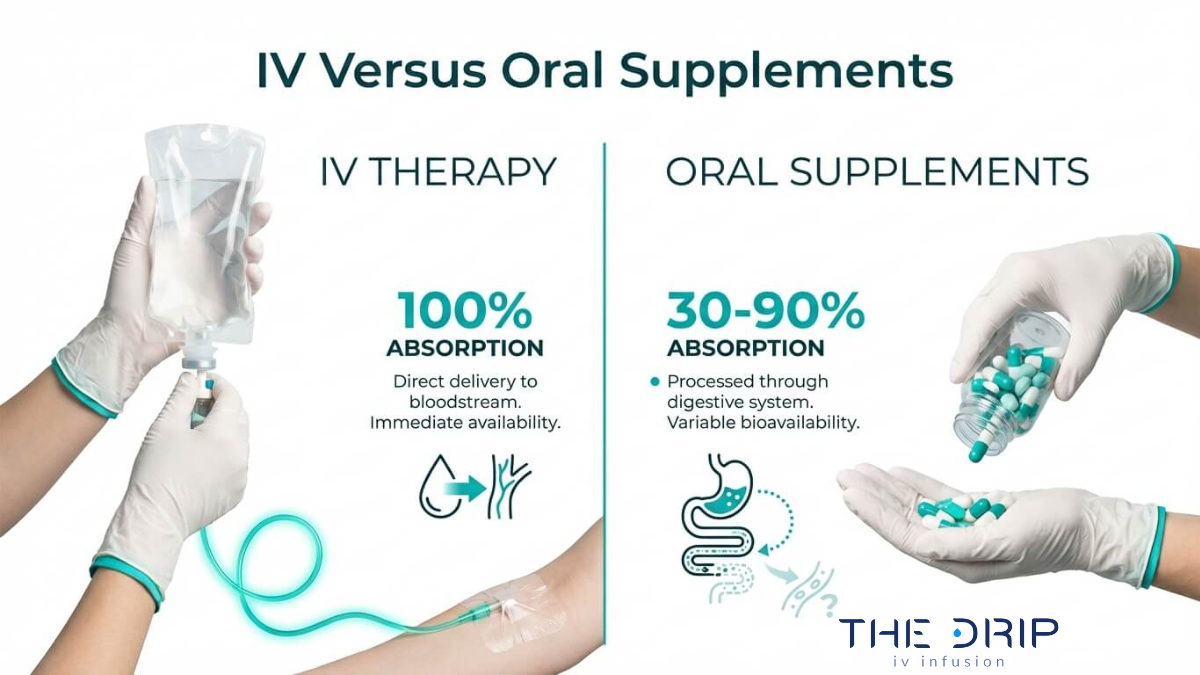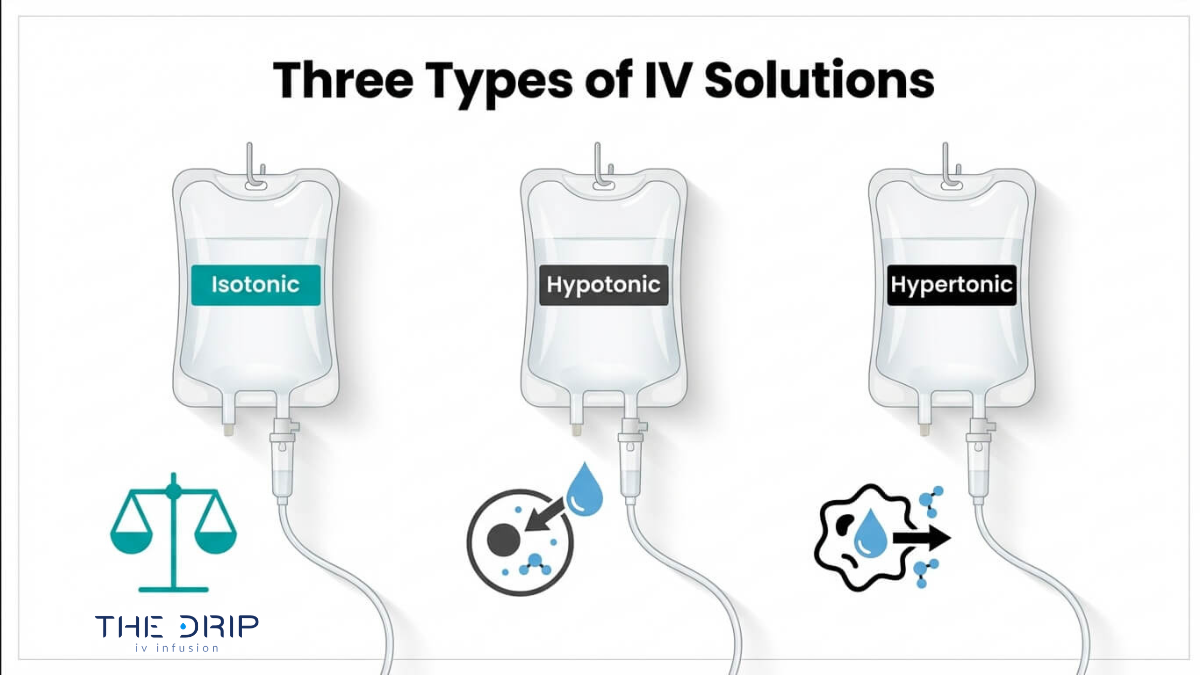
An IV bolus is a method of delivering medication directly into your bloodstream all at once. It’s given as a rapid push through a vein so the full dose reaches your system within 3–5 minutes. Doctors sometimes call it an “IV push,” but it’s the same thing. About 9 out of 10 hospital patients receive some form of this treatment.
TL;DR Summary:
- Understanding IV Bolus: This is medicine delivered fast and direct into your veins. No delays, no waste – straight to work.
- Administration Process: There are key steps your medical team follows, though studies show mistakes happen in over 77% of these procedures.
- IV Bolus vs. Infusion: Bolus dumps all the medicine in at once (3-5 minutes). Infusion drips it in slowly over hours.
- Clinical Applications: Emergency situations like severe infections need this fast approach – 30 mL/kg of fluids within 3 hours can save lives.
- Safety Considerations: Going too fast can shock your system. Most serious mistakes happen when nurses rush the 3-5 minute rule.
- Quick Tip: Make sure your nurse takes the full 3-5 minutes. Rushing this step causes 95 out of 101 dangerous mistakes that doctors have tracked.
We’re going to walk you through everything about IV bolus. From how it works in your body to what keeps you safe. Whether you’re heading into a procedure or just want to understand what’s happening, we’ve got the latest research to help you feel informed.
How Does an IV Bolus Work?
An IV bolus works by delivering medication straight into the bloodstream so it begins acting immediately. Once injected, your blood circulates the drug throughout the body. How quickly it works depends on blood flow, molecule size, and how your body distributes it. This distribution is measured by “volume of distribution,” which reflects how much space the drug occupies in your tissues.
What Steps Are Involved in Administering an IV Bolus?
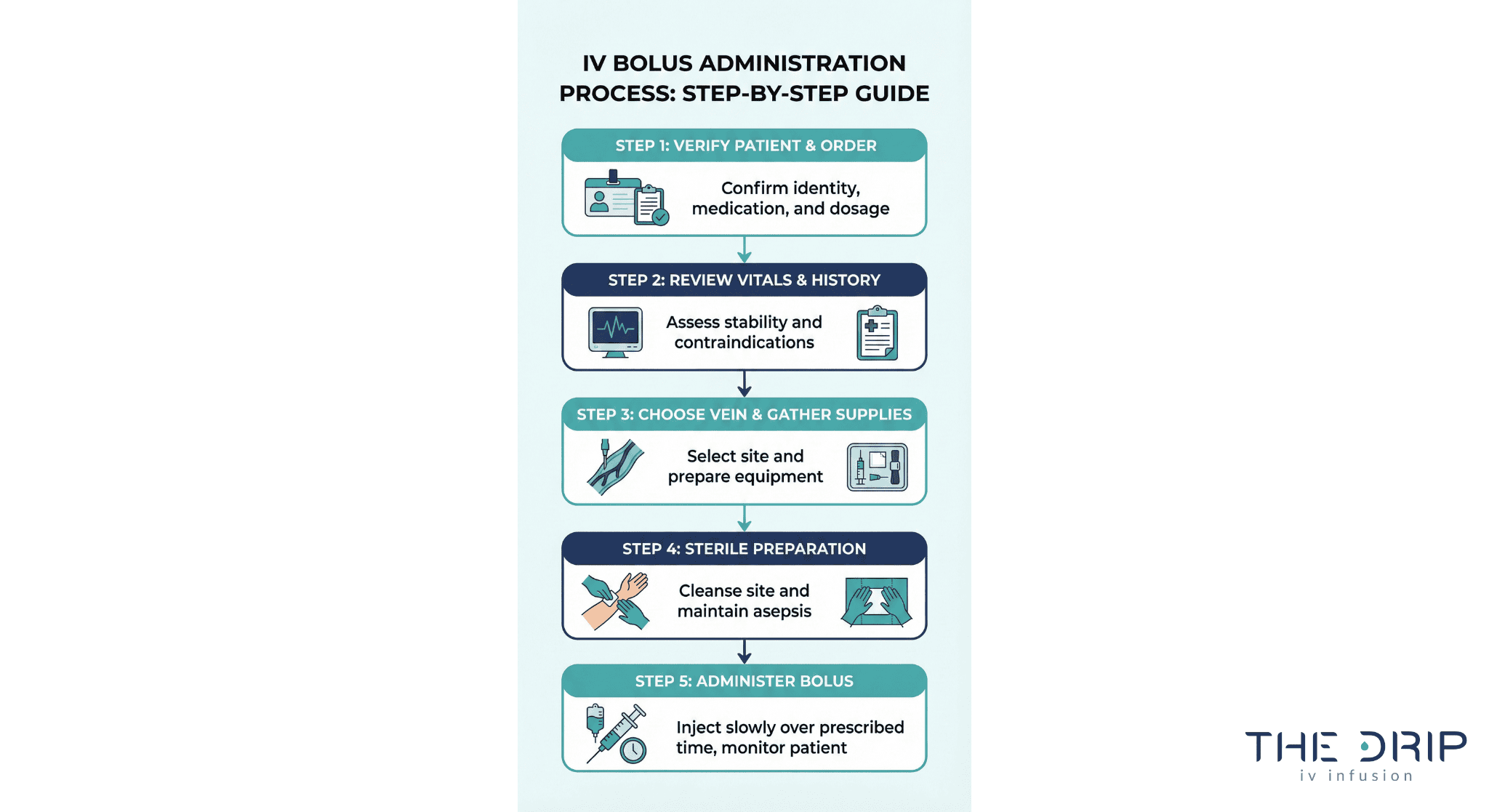
Administering an IV bolus requires several safety steps that nurses follow to prevent errors. Each step ensures medication reaches your bloodstream correctly and safely. Here are the key stages of the process:
- Verify the correct patient.
- Review vitals and lab results.
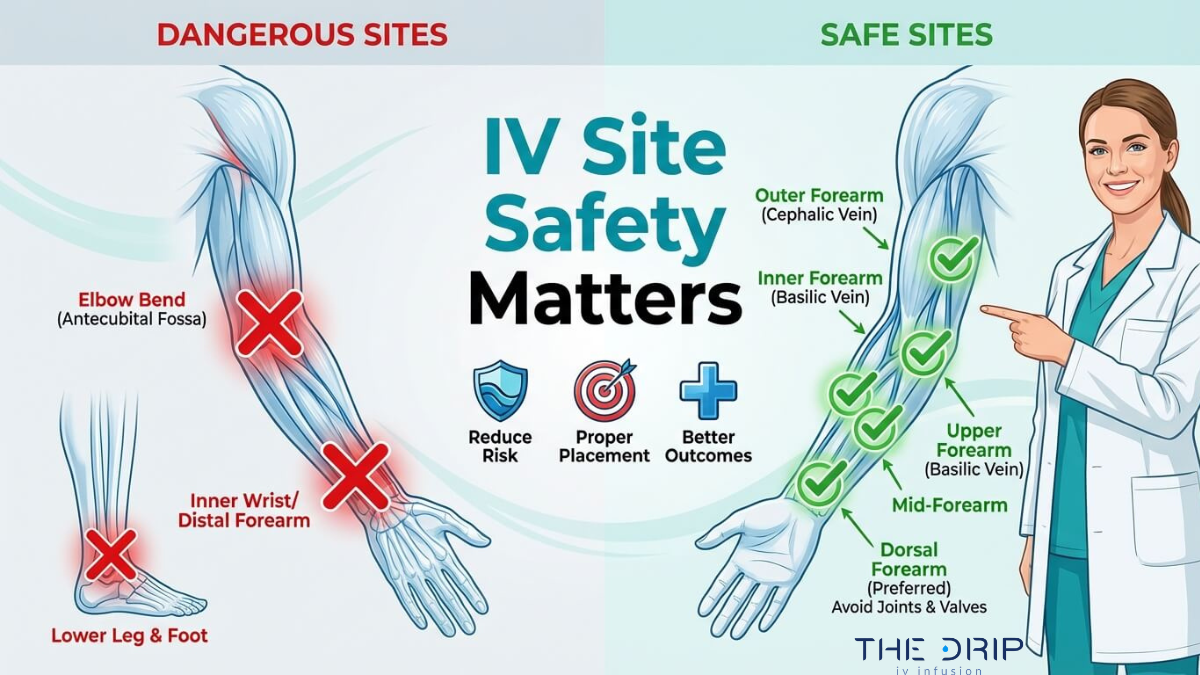
- Select an appropriate vein and needle size.
- Maintain sterile technique.
- Prepare and mix the medication properly.
What Medications or Fluids Are Commonly Delivered by IV Bolus?
IV bolus antibiotics differ in how quickly they must be administered. This table shows standard timing guidelines.
| Medication | Required Push Time |
| Meropenem | 3–5 minutes |
| Cefazolin | 3–5 minutes |
| Cefotaxime | Minimum 3–5 minutes |
| Cefotetan | 3–5 minutes |
| Cefepime | 2–5 minutes |
Antibiotics like gentamicin need to be watered down with saline before they go in. Pain medicines and anxiety drugs make up over 83% of what nurses have to dilute. Emergency medicines handle heart attacks, overdoses, and when your blood pressure crashes. For serious infections, you might need 30 mL/kg of fluids within 3 hours.
How Quickly Does an IV Bolus Take Effect?
An IV bolus takes effect almost instantly because the medication enters the bloodstream immediately. Drugs like furosemide start working within about 5 minutes when given IV versus up to an hour orally. Most IV bolus medications reach peak effect in under a minute, which is why doctors rely on them in emergencies.
What Is the Difference Between IV Bolus and IV Infusion?
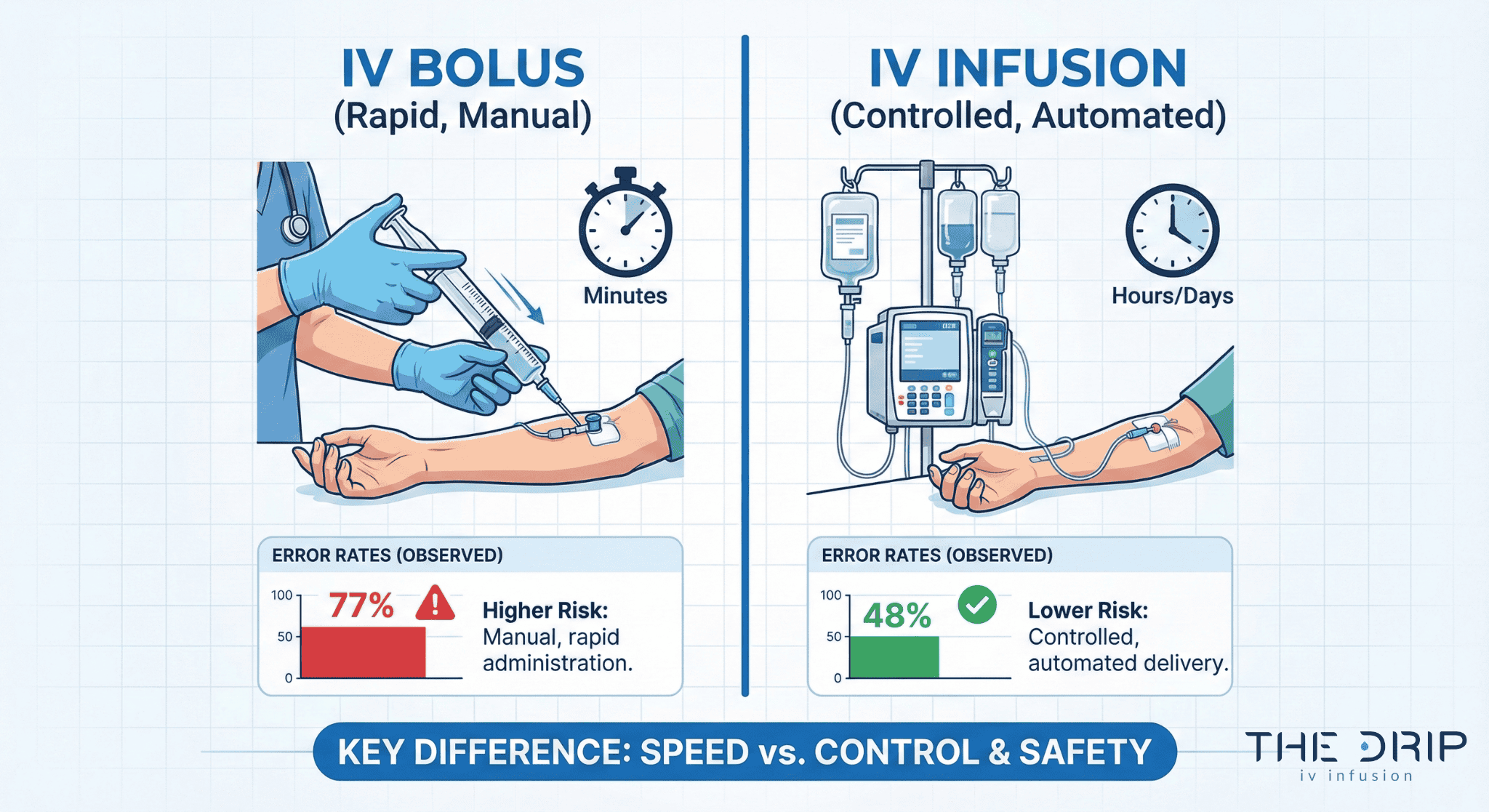
The difference between an IV bolus and an IV infusion is the speed and volume at which the medication enters your bloodstream. A bolus pushes the full dose in at once using a small amount of fluid, while an infusion drips slowly over hours using larger fluid volumes.Error rates differ significantly between bolus and infusion methods. The table below summarizes how often mistakes occur in each technique and how serious they can be.
| Method | Overall Error Rate | Serious Error Rate |
| IV Bolus | 77% | 23% |
| IV Infusion | 48% | 11% |
Research shows bolus methods have a higher error rate—77% versus 48% for infusions. Bolus gives you instant relief. Infusion keeps steady levels in your system.
How Do the Methods of Administration Differ?
The methods of administering an IV bolus versus an IV infusion differ in the equipment used and the level of safety control. Bolus doses are pushed manually with a syringe over 3–5 minutes, while infusions rely on automated smart pumps that prevent many errors.
When Is an IV Bolus Preferred Over an IV Infusion?
An IV bolus is preferred over an IV infusion when treatment must work immediately or when patients cannot tolerate large fluid volumes. Emergencies like heart attacks, overdoses, and severe infections demand rapid action. Research shows IV push antibiotics start 6 minutes faster than infusions.
Pain and nausea need fast relief, not a slow buildup. Sometimes hospitals run short on IV bags, so they conserve by using bolus instead.
What Are the Clinical Scenarios for Choosing IV Infusion Instead?
IV infusion is chosen instead of a bolus when medications require controlled delivery or carry risks if given too quickly. Drugs with narrow safety ranges or long-term therapy needs must enter the bloodstream slowly. Large fluid replacement and medicines formulated for gradual infusion also require this method.
How Does IV Push Compare to IV Bolus?
IV push is identical to an IV bolus because both terms describe the same rapid injection technique. The FDA uses the terms interchangeably, and medical staff treat them as synonyms in practice.
Are IV Push and IV Bolus the Same Thing?
Yes, they’re identical. Nursing textbooks use both terms to describe the exact same technique. Same syringe, same timing, same everything. The big medication safety summit in 2015 used both words interchangeably throughout their guidelines. When they surveyed 1,773 nurses, nobody could tell the difference between the two terms in actual practice.
What Are the Potential Risks and Benefits of Each Method?
The potential risks and benefits of IV bolus administration include rapid therapeutic effects but also higher chances of dosing errors if given too quickly. Speed shock is the most serious risk, while instant relief and efficient drug delivery are key benefits.
When Might a Healthcare Provider Choose IV Push Instead of Bolus?
A healthcare provider does not choose IV push instead of IV bolus because the two terms describe the same technique. The real choice is between rapid (push/bolus) and slow (infusion) delivery.
Why Is an IV Bolus Given?
An IV bolus is given to provide rapid medication effects when immediate treatment is essential. It bypasses the digestive system, works within seconds, and uses minimal fluid for patients who can’t tolerate more.
What Medical Conditions Require IV Bolus Administration?
IV bolus is used in several urgent medical situations where treatment must work immediately. Conditions that require rapid administration include:
- Life-threatening infections
- Heart attacks and dangerous arrhythmias
- Drug overdoses
- Severe pain
- Continuous seizures
- Severe allergic reactions

What Are the Advantages of Using an IV Bolus?
You get 100% of your medicine instantly. No waste, no delay. Antibiotics get started 6 minutes faster than with slow drips. Every drop of medicine gets where it needs to go – none gets stuck in tubing. It’s faster to set up than infusions. No repeated needle pokes like with shots in your muscle. More reliable than other injection methods.
What Are the Possible Side Effects or Risks of IV Bolus?
Speed shock is the biggest danger – too fast and it can stop your heart or make you feel like you’re dying. Wrong speed accounts for 95 out of 101 serious errors doctors have tracked. Life-threatening heart rhythms happened when one antibiotic was given too fast through a central line.
A 2015 study found over 25% of IV errors were serious enough to potentially cause significant harm. Vein irritation gets worse when strong medicines go into small veins. Knowing these risks helps your medical team keep you safe.

How Can You Safely Receive IV Bolus Therapy with The Drip IV Infusion?
The Drip IV Infusion keeps you safe by using licensed medical professionals who follow proven safety rules. Their nurses are trained in the latest safety guidelines for IV administration. They double-check your identity, examine your veins carefully, and keep everything sterile during procedures. Research from 2018 shows that experienced nurses make 11% fewer mistakes each year during their first six years of practice.
Can The Drip IV Infusion Help You With IV Bolus or Other IV Treatments?
Yes. The Drip IV Infusion can help you with IV bolus and other IV treatments through both mobile and clinic-based services. Their licensed medical team handles hydration therapy, vitamin infusions, and wellness treatments using both bolus and infusion methods with smart-pump safety technology.They check your vital signs first, verify your medications, and watch you throughout the process.
What Are the Key Takeaways About IV Bolus?
The key takeaways about IV bolus are that it works instantly, has a higher error rate than infusions, and requires strict timing for safe administration. Error rates can reach 77%, making experienced nurses crucial to reducing risk.