If you’re recovering from surgery, managing a chronic wound, or simply concerned about optimal healing, you’re likely exploring every option to speed up recovery and minimize complications. We understand that wound healing can be a frustrating, lengthy process that impacts your quality of life, and you’re searching for evidence-based solutions that actually work. You’re in the right place—we’ll show you exactly how IV nutrient therapy can accelerate your healing journey through direct, scientifically-proven methods.
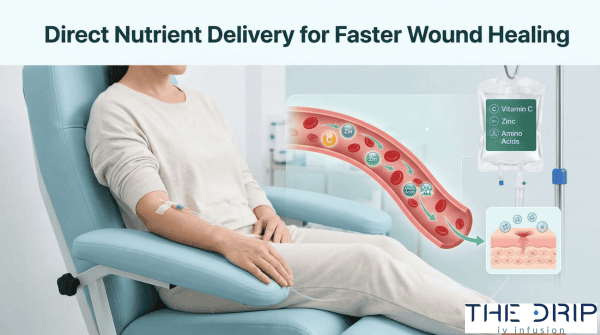
IV therapy for wound healing is a medical treatment that delivers essential nutrients—including vitamin C, zinc, amino acids, and B-complex vitamins—directly into the bloodstream through an intravenous catheter, bypassing the digestive system to achieve nearly 100% bioavailability and support all four phases of wound healing: hemostasis, inflammation, proliferation, and maturation.
TL;DR Summary: We’ll explore the key differences between acute wounds (like surgical incisions) and chronic wounds (such as diabetic ulcers), explaining why malnourished patients and those with digestive disorders particularly benefit from IV therapy’s superior bioavailability compared to oral supplements. You’ll learn about specific IV formulations like the Myers’ Cocktail and specialized wound healing blends containing critical nutrients like arginine for collagen synthesis, glutamine for infection reduction, and vitamin C for tissue repair. We’ll present clinical evidence showing IV nutrition can increase wound healing markers by 158% and reduce healing time to 48 days, while also covering the core benefits of accelerated recovery, enhanced immune response, and reduced complications. Finally, we’ll address important safety considerations, potential side effects ranging from mild bruising to serious complications in at-risk patients, and provide practical guidance on accessing IV therapy through The Drip IV Infusion, including cost comparisons ($150-$400 per session versus $50-$200/month for oral supplements) and what to expect from treatment protocols.
Quick Tip: If you’re considering IV therapy for wound healing, schedule your consultation during the pre-operative period rather than waiting until after surgery—research shows preoperative IV nutrition produces significantly better healing outcomes than post-operative administration.
What Are the Main Types of Wounds That May Benefit From IV Therapy?
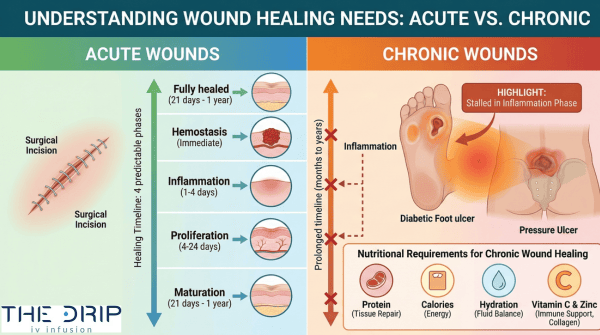
The main types of wounds that may benefit from IV therapy are acute wounds such as surgical incisions and chronic wounds including pressure ulcers, diabetic foot ulcers, and venous leg ulcers. Acute wounds follow predictable healing through four phases: hemostasis for bleeding control, inflammation during days 1-4, proliferation from days 4-21 with granulation tissue formation, and maturation for tissue strengthening. Chronic wounds require higher nutritional support, including 30-35 kcal/kg/day energy, 1.25-1.5 g/kg/day protein, and 30 mL/kg water for pressure injuries. The following sections examine how different wound types respond to IV nutritional support and which patient conditions affect healing outcomes.
How Do Acute and Chronic Wounds Differ in Their Healing Needs?
Acute and chronic wounds differ in their healing needs through duration, nutritional demands, and micronutrient requirements. Acute wounds like surgical incisions progress through hemostasis, inflammation (days 1-4), proliferation (days 4-21), and maturation phases sequentially. Chronic wounds such as pressure ulcers, diabetic ulcers, and venous leg ulcers remain stuck in the inflammatory phase and require 30-35 kcal/kg/day energy, 1.25-1.5 g/kg/day protein, and 30 mL/kg water intake.
Essential micronutrients vary by healing phase. Calcium, vitamin K, vitamin A, vitamin E, and zinc support the inflammation phase of wound healing. During proliferation, collagen synthesis demands increased vitamin C and amino acids. The maturation phase requires sustained protein intake for tissue remodeling. These distinct nutritional requirements determine whether IV therapy protocols emphasize rapid micronutrient delivery for acute wounds or sustained supplementation for chronic conditions.
Which Patient Conditions Typically Affect Wound Healing Outcomes?
Patient conditions that typically affect wound healing outcomes include malnutrition, protein deficiency, and malabsorptive disorders. Malnourished patients experience higher rates of impaired healing, skin breakdown, and wound dehiscence. Protein malnutrition specifically impairs collagen synthesis and immune function during recovery.
Gastrointestinal conditions drastically reduce oral supplementation efficacy. Patients with Crohn’s disease, celiac disease, IBS, and other malabsorptive disorders may absorb less than 20% of oral nutrients. Preoperative nutritional support correlates with reduced hospital stays and fewer complications. These conditions create scenarios where IV therapy bypasses compromised digestive systems to deliver nutrients directly for wound healing support.
What Is IV Therapy and How Does It Deliver Nutrients for Healing?
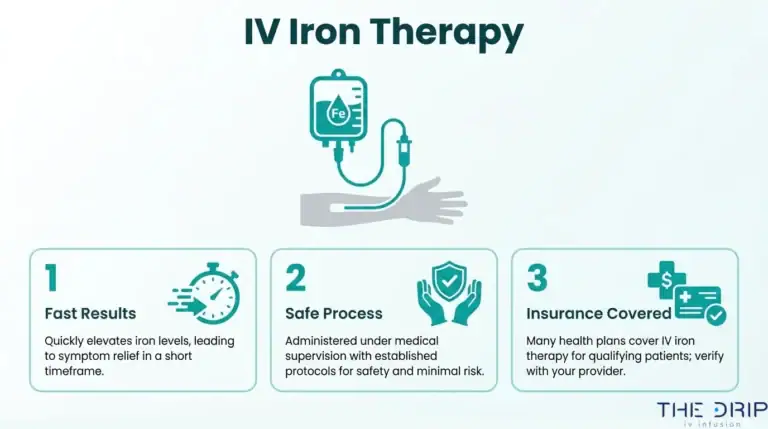
IV therapy is the direct administration of fluids, vitamins, minerals, and medications into the bloodstream through an intravenous catheter. This medical technique bypasses the digestive system entirely, delivering nutrients directly to cells and tissues that need them for wound repair and recovery. The process involves inserting a small catheter into a vein, typically in the arm, and infusing a customized solution over 30-60 minutes while monitoring vital signs throughout the session.
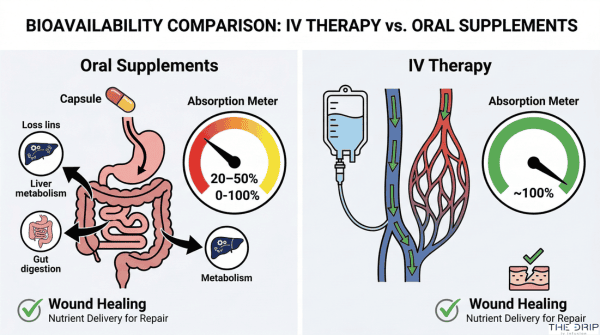
The key advantage of IV therapy lies in its ability to achieve nearly 100% bioavailability compared to oral supplementation’s limited absorption rates. When nutrients enter directly into circulation, they reach therapeutic levels immediately without loss through digestive processes or liver metabolism. This direct delivery method proves especially valuable for wound healing, where rapid nutrient availability can significantly impact recovery outcomes.
How Does IV Therapy Work Compared to Oral Supplements for Wound Care?
IV therapy achieves nearly 100% bioavailability with nutrients entering the bloodstream directly without digestive processes. This complete absorption contrasts sharply with oral supplementation, which typically achieves only 20-50% bioavailability depending on the nutrient. Factors limiting oral absorption include gastric acidity, digestive enzymes, and individual gut health variations.
IV vitamin C administration achieves plasma levels up to 100 times higher than oral intake. When taken orally, vitamin C absorption becomes saturated at relatively low doses—oral intake exceeding 1 gram shows significantly diminished absorption rates. The digestive system simply cannot process higher amounts efficiently, leading to waste and potential gastrointestinal discomfort.
IV administration circumvents hepatic first-pass metabolism where oral nutrients lose potency through liver processing. This metabolic bypass means nutrients maintain their full therapeutic strength when reaching target tissues. The difference proves critical for wound healing, where high concentrations of specific nutrients like vitamin C, zinc, and amino acids directly influence collagen synthesis and tissue repair rates.
What Types of IV Formulations Are Used in Wound Healing?
The types of IV formulations used in wound healing are specialized nutrient combinations designed to support tissue repair and immune function. Myers’ Cocktail contains customized vitamins and minerals originally developed for chronic fatigue, migraines, and stress management. This foundational formula often serves as a base for more targeted wound healing protocols.
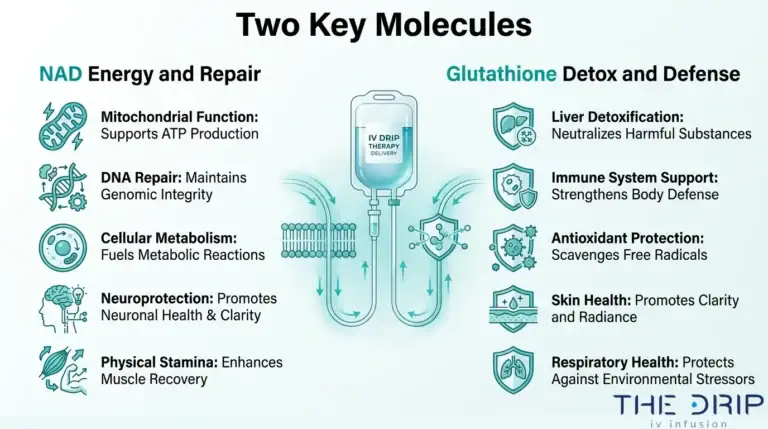
Wound Healing IV formulations include specific nutrients such as Vitamin C, Magnesium, Zinc, Proline, Taurine, Glutathione, and B-Complex vitamins. Each component plays distinct roles: Vitamin C supports collagen synthesis, Zinc facilitates re-epithelialization, Proline provides building blocks for new tissue, and Glutathione offers antioxidant protection during the inflammatory phase.
Standard IV infusion sessions last 30-60 minutes depending on the volume and complexity of the solution. The process includes an initial consultation for medical history assessment, followed by solution customization tailored to individual needs. Healthcare providers insert the catheter using sterile technique and monitor vital signs throughout the infusion to ensure safety and comfort.
These specialized formulations can be adjusted based on wound type, healing phase, and individual patient factors to optimize recovery outcomes.
Which Key Nutrients in IV Therapy Benefit Wound Healing Most?
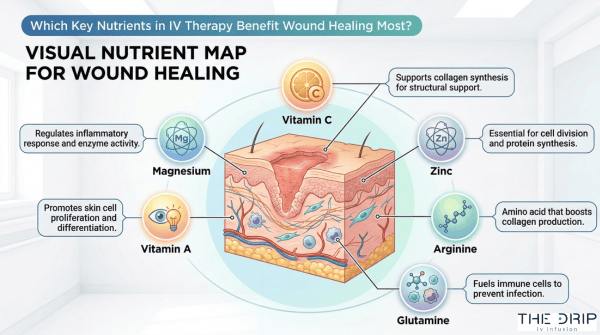
IV therapy delivers essential nutrients directly into the bloodstream to support wound healing. The key nutrients include amino acids like arginine and glutamine, vitamins C and A, B-complex vitamins, and minerals such as zinc and copper. These nutrients work together to enhance collagen synthesis, reduce inflammation, and accelerate tissue repair processes.
How Do Amino Acids, Vitamins, and Minerals Assist Tissue Repair?
Amino acids, vitamins, and minerals assist tissue repair through multiple biochemical pathways that support collagen formation, immune function, and cellular regeneration. Arginine supports collagen synthesis, growth hormone production, and T cell activation. Glutamine reduces infection and inflammation while serving as a glutathione precursor.
Vitamin C enables collagen synthesis, provides antioxidant protection, and supports angiogenesis. Vitamin A promotes epithelial cell growth and fibroblast stimulation. B-complex vitamins support leukocyte generation and collagen synthesis. Vitamin D upregulates immune system function.
| Essential Healing Nutrient | Primary Biological Function | Wound Healing Phase Supported |
| Zinc | Re-epithelialization, immune response | Proliferation |
| Copper | Growth factor modulation | All stages |
| Iron | Oxygen transport, tissue perfusion | Maturation |
| Magnesium | CRP reduction, antioxidant capacity | Inflammation |
A 12-week magnesium regimen may improve ulcer size and glucose metabolism. These minerals work synergistically to facilitate wound closure and tissue regeneration.
What Role Do Antioxidants and Hydration Play in the Healing Process?
Antioxidants and hydration play critical roles in the healing process by reducing oxidative stress and maintaining optimal cellular function. Glutathione facilitates enzymatic reactions and cell membrane reinforcement. According to trauma patient studies, antioxidant and glutamine supplementation shortened wound closure time to 29 and 58 days respectively.
Hydration therapy effects from IV administration last several days with results noticeable within hours. Proper hydration maintains tissue perfusion and nutrient delivery to wound sites. The combination of antioxidants and adequate hydration creates an optimal environment for cellular repair and regeneration.
What Are the Core Benefits of IV Therapy for Wound Recovery?
The core benefits of IV therapy for wound recovery are accelerated healing time, reduced complications, and strengthened immune response. IV nutritional support delivers essential nutrients directly to tissues, bypassing digestive limitations that affect wound patients. These benefits manifest through improved collagen synthesis and enhanced cellular repair mechanisms.
Does IV Therapy Accelerate Healing Time and Reduce Complications?
IV therapy accelerates healing time by increasing collagen production markers and reducing overall recovery periods. A 1987 study by Haydock & Hill examining 90 surgical patients found IV nutrition increased hydroxyproline levels from 0.34±0.23 μg/cm to 0.88±0.62 μg/cm (p<0.005). Hydroxyproline serves as a direct marker of collagen synthesis in wound tissue.
The timing of IV administration affects outcomes significantly. Week 1 of IV therapy yielded 0.36±0.24 μg/cm hydroxyproline, while week 2 reached 0.78±0.67 μg/cm (p<0.005). Preoperative IV nutrition proved more effective than postoperative administration (p<0.02).
Aggressive wound care protocols incorporating nutritional support achieve superior healing rates. Studies demonstrate 92% one-year healing rates with aggressive care versus 80% with standard care. Mean healing time reduced to 48 days with comprehensive IV nutritional support.
Clinical cases support these findings. A 45-year-old female post-abdominal surgery showed marked improvement in energy and accelerated wound healing when IV therapy combined with hyperbaric oxygen treatment. The dual approach addresses both nutritional deficits and tissue oxygenation simultaneously.
Can IV Therapy Strengthen Immune Response During Recovery?
IV therapy strengthens immune response during recovery through targeted immunonutrition delivery. Immunonutrition decreases wound complications and improves the healing process in specific clinical circumstances. The rapid onset distinguishes IV therapy from oral supplementation methods.
Recovery-focused IV therapy benefits manifest quickly with sustained effects. Benefits last 1-2 days with onset of effects within hours of administration. This rapid response proves crucial for post-surgical patients requiring immediate immune support.
Clinical evidence demonstrates immune enhancement through IV therapy. A 32-year-old male with chronic fatigue syndrome experienced substantial energy increase and symptom reduction with IV therapy plus hyperbaric oxygen. The combination therapy addresses both immune dysfunction and cellular energy production.
These core benefits position IV therapy as an effective intervention for wound recovery when administered under proper medical supervision at facilities like The Drip IV Infusion.
Are There Risks, Contraindications, or Side Effects of IV Therapy for Wounds?
IV therapy for wounds carries specific risks and contraindications that patients should understand before treatment. Medical providers assess individual risk factors to determine suitability for intravenous nutrient administration during wound recovery.
The following sections detail contraindications for specific patient populations and potential side effects from IV wound therapy.
Who Should Avoid or Take Precautions With IV Therapy in Wound Care?
Patients receiving intravenous antibiotics face elevated complication risks. A clinical analysis found intravenous antibiotics are a strong risk factor for infiltration/occlusion (HR 1.40, 95% CI 1.27-1.53) and phlebitis (HR 1.36, 95% CI 1.18-1.56).
There are specific patient groups requiring precautions:
• Patients with fluid overload risk (hypervolemia)
• Individuals with documented allergic reactions
• Those prone to anaphylaxis from IV components
Medical screening identifies contraindications before initiating IV wound therapy protocols.
What Side Effects or Interactions Might Patients Experience?
Side effects from IV wound therapy fall into two categories: local complications and systemic reactions.
Local complications occur at the insertion site:
• Pain, swelling, and redness
• Bruising around catheter area
• Phlebitis (vein inflammation)
• Infiltration (fluid leaking into tissue)
• Extravasation (tissue damage from leaked medication)
Systemic complications affect the entire body:
• Infection or sepsis risk
• Fluid overload symptoms
• Mineral toxicity from excessive doses
Mild effects may include headache, nausea, fatigue, chills, low-grade fever, and metallic taste. These symptoms typically resolve within hours after infusion completion.
Understanding potential risks enables patients to make informed decisions about IV therapy for wound healing with their healthcare providers at The Drip IV Infusion.
How Should You Approach IV Therapy for Wound Healing With The Drip IV Infusion?
IV therapy for wound healing requires careful consideration of nutrient formulations, cost factors, and provider expertise. The Drip IV Infusion offers specialized wound healing protocols that deliver essential nutrients directly to tissues needing repair. Treatment approaches vary based on wound type, patient health status, and specific nutritional deficiencies identified during consultation.
Can The Drip IV Infusion’s Services Help With Nutrient Support For Wound Healing?
The Drip IV Infusion’s services may help with nutrient support for wound healing through customized IV formulations and flexible pricing options. Basic hydration IV costs $100-$150, while Vitamin C infusions range $125-$435 and Myers’ Cocktail runs $190. Specialized wound healing treatments cost $115-$400+ depending on nutrient complexity.
Cost comparison reveals oral supplements cost $50-$200 monthly versus $150-$400 per IV session. Membership programs at $150 monthly include one standard IV drip valued up to $200, showing 30-50% higher retention rates. Package deals reduce per-session costs by 15-30%.
Location affects pricing with urban clinics charging 20-30% more than rural locations. Mobile IV services add $50-$100 to base prices. The Drip IV Infusion’s wound healing protocols may include vitamin C, zinc, glutathione, and amino acids tailored to individual recovery needs.
What Are the Key Takeaways About IV Therapy and Wound Healing Benefits and Nutrients We Covered?
The key takeaways about IV therapy and wound healing benefits include market growth, treatment categories, and regulatory standards. The IV hydration therapy market shows projected CAGR of 7.98% from 2025-2034 with North America dominating market share.
Energy and focus formulations containing NAD+ and B12 capture 25-28% market share. Longevity and skin health treatments featuring glutathione and vitamin C demonstrate fastest growth rates. Regular IV therapy may reduce illness frequency, productivity loss, and reactive medical care costs.
FDA Section 503A regulates IV compounding practices. USP Chapter 797 sterile compounding standards became effective November 1, 2023. These regulations ensure safety and quality in IV therapy preparations for wound healing applications at facilities like The Drip IV Infusion.