Mobile IV therapy is a wellness service that delivers intravenous hydration, electrolytes, and vitamins directly to a golfer’s hotel, rental home, or clubhouse in Scottsdale. For golfers facing desert conditions that silently drain performance, it offers a faster, more complete rehydration solution than water or sports drinks alone.
This guide covers Scottsdale’s unique climate challenges for golfers, the physiological toll of playing in extreme heat, how IV therapy targets specific performance and recovery needs, optimal scheduling and drip ingredients, and how mobile delivery fits a golf trip itinerary.
Scottsdale’s combination of triple-digit temperatures, deceptively low humidity, and sustained UV exposure creates conditions that accelerate fluid and electrolyte loss far beyond what most golfers anticipate. Sweat evaporates instantly in dry desert air, removing the visible cues players rely on to gauge dehydration, while cumulative sun exposure compounds fatigue through the back nine.
The physiological consequences are measurable. Even mild dehydration reduces shot distance, nearly doubles errors in distance judgment, and degrades the muscle coordination essential for a repeatable swing. Water alone cannot reverse these deficits because it replaces volume without restoring the sodium, magnesium, and B vitamins lost through sustained perspiration.
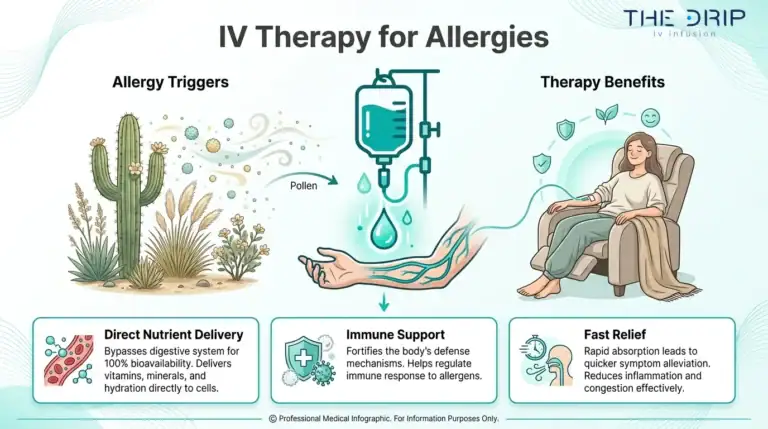
IV therapy addresses this gap by delivering fluids and nutrients directly into the bloodstream, bypassing the digestive bottleneck that limits oral absorption during heat stress. Golfers can choose targeted formulations, from the broad-spectrum Myers’ Cocktail to add-ons like glutathione for oxidative stress, and schedule sessions the night before a round or immediately after play for faster recovery.
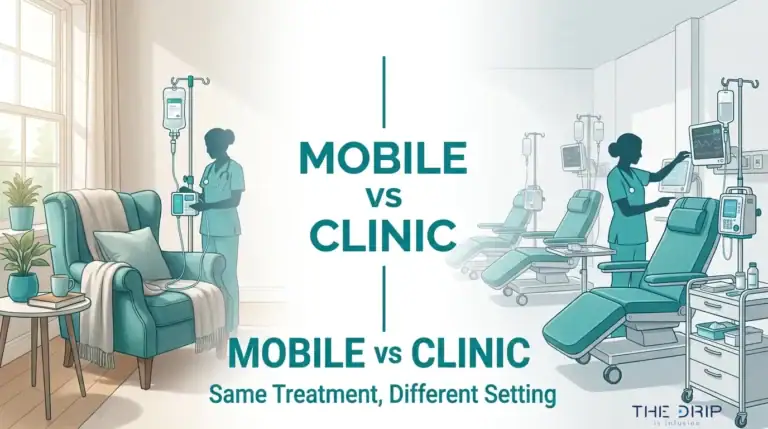
The mobile format is what makes this practical for visiting golfers. A registered nurse arrives on location, completes the session in about an hour, and fits the entire process around tee times, dinners, and group schedules without a single clinic visit.
Why Does Scottsdale’s Desert Climate Challenge Golfers?
Scottsdale’s desert climate challenges golfers through extreme heat, deceptively low humidity, and prolonged sun exposure across a four-to-five-hour round. Each factor compounds the others, creating conditions that drain the body faster than most players expect.
How Does Extreme Heat Accelerate Dehydration on the Course?
Extreme heat accelerates dehydration on the course by forcing the body to divert blood flow toward the skin for cooling, increasing sweat output well beyond what most golfers replace through casual sipping. Summer temperatures in Scottsdale regularly exceed 100°F, and a typical 18-hole round keeps players exposed for four hours or more.
A study published in Temperature found that perceived dehydration carries an adjusted odds ratio of 4.65 for exertional heat exhaustion-related symptoms among amateur golfers. That nearly fivefold increase in risk underscores how quickly the desert strips fluid reserves. For golfers unaccustomed to sustained heat exposure, the deficit often builds silently before symptoms like dizziness or cramping appear.
Why Is Scottsdale’s Low Humidity Deceptive for Golfers?
Scottsdale’s low humidity is deceptive for golfers because dry air evaporates sweat almost instantly, removing the visible cue most people rely on to gauge fluid loss. In humid climates, sweat pools on the skin, signaling the need to drink. In Scottsdale’s arid conditions, that feedback loop breaks down entirely.
Golfers may feel relatively comfortable even as their body sheds significant amounts of water and sodium through rapid evaporation. This false sense of comfort delays rehydration efforts, allowing fluid deficits to accumulate across holes without warning. The lack of perceived sweatiness becomes a genuine hazard, especially for visiting players who are calibrated to more humid environments and underestimate how aggressively dry desert air pulls moisture from the body.
How Does Sun Exposure Over 18 Holes Compound Fatigue?
Sun exposure over 18 holes compounds fatigue by adding thermal stress on top of physical exertion. Direct UV radiation raises core body temperature independently of ambient heat, forcing the cardiovascular system to work harder to regulate internal conditions. Over a full round, this cumulative load drains energy reserves that golfers need for concentration and swing consistency.
Sustained UV exposure also triggers an inflammatory response in the skin, redirecting metabolic resources toward tissue repair. Combined with fluid loss from heat and low humidity, the effect is a layered fatigue that worsens progressively through the back nine. Most golfers notice a sharper decline in focus and motor control during the final holes, precisely when these compounding stressors peak.
Understanding how Scottsdale’s climate taxes the body sets the stage for exploring what happens physiologically during a round in the heat.
What Happens to a Golfer’s Body During a Round in the Heat?
A golfer’s body undergoes rapid electrolyte depletion, cognitive decline, and progressive muscle fatigue during a hot round. These three physiological responses compound across 18 holes, degrading performance from tee to green.

How Quickly Do Golfers Lose Electrolytes Through Sweat?
Golfers lose electrolytes through sweat within the first few holes of a hot round, and the rate accelerates as core temperature rises. Sodium, the primary electrolyte lost in perspiration, varies significantly by individual. According to a study published in Sports Medicine, sodium content in sweat ranges from 230 to 2,070 mg/L depending on the person and exercise intensity. Over a four-to-five-hour round in Scottsdale’s desert heat, this sustained sodium loss disrupts nerve signaling, fluid balance, and muscle contraction. Potassium and magnesium follow closely behind, quietly depleting reserves that oral sipping alone struggles to replace at the rate they are lost.
What Cognitive Effects Does Dehydration Have on Golf Performance?
Dehydration has measurable cognitive effects on golf performance, impairing both decision-making and distance perception well before a golfer feels noticeably thirsty. A 2012 study published in the Journal of Strength and Conditioning Research found that mild dehydration of just 1 to 3% body mass loss reduced shot distance from 128.6 m to 114.6 m, an 11% decrease. Equally concerning, cognitive performance suffered as mean error in distance judgment to the target increased from 4.1 m to 8.8 m. For a sport where club selection and yardage reads determine outcomes, this level of impairment turns manageable approach shots into costly misses. Even slight fluid deficits quietly erode the mental sharpness golf demands.
How Does Muscle Fatigue From Fluid Loss Affect a Golf Swing?
Muscle fatigue from fluid loss affects a golf swing by reducing the contractile efficiency of muscles responsible for power, rotation, and stability. Dehydrated muscle fibers generate less force, which translates directly to slower clubhead speed and diminished control through impact. The trunk, forearms, and hip rotators are particularly vulnerable because they perform repeated high-velocity movements across 70 or more full swings per round. As intracellular fluid drops, muscles become prone to cramping and delayed firing patterns that disrupt swing tempo. What feels like a “tired swing” on the back nine is often a biomechanical consequence of progressive dehydration, not simply physical exhaustion.
With the body working against itself under desert conditions, understanding why water alone falls short becomes essential.
Why Can’t Drinking Water Alone Keep Golfers Hydrated?
Drinking water alone cannot keep golfers hydrated because sweat depletes electrolytes, minerals, and sodium that plain water does not replace. When golfers drink only water during a round in Scottsdale’s heat, they dilute remaining electrolyte concentrations without restoring what was lost. This creates an imbalance that accelerates fatigue, impairs muscle function, and compromises cognitive sharpness.
According to a study published in Sports Medicine, sodium content in sweat ranges from 230 to 2,070 mg/L depending on the individual and exercise intensity. Over four to five hours of golf in desert conditions, that loss accumulates significantly. Water replenishes fluid volume, but it contains no sodium, potassium, magnesium, or B vitamins to offset these deficits.
The gastrointestinal tract also limits oral absorption rates. Even when golfers drink consistently, the stomach can only process a finite amount of fluid per hour. Much of what is consumed passes through without full absorption, particularly when heat stress diverts blood flow away from the digestive system and toward the skin for cooling. This bottleneck means golfers often fall behind on hydration despite steady water intake.
Proper hydration for athletic performance in extreme heat requires replacing both fluid and the specific micronutrients lost through perspiration. For golfers navigating Scottsdale’s courses, understanding this gap between water intake and true rehydration is what makes targeted solutions like IV therapy worth considering.
What Is Mobile IV Therapy and How Does It Work for Golfers?
Mobile IV therapy is a wellness service that delivers intravenous hydration, electrolytes, and nutrients directly to a golfer’s location. The process bypasses the digestive system for faster absorption, making it practical for athletes dealing with Scottsdale’s demanding desert conditions. Here is how the service works and what golfers can expect from a typical session.
An experienced nurse arrives at the golfer’s hotel, rental home, or clubhouse with all necessary supplies. After a brief health screening, the nurse inserts a small IV catheter, typically in the forearm, and connects a customized fluid bag. The infusion delivers a saline base mixed with electrolytes, B vitamins, magnesium, vitamin C, or other add-ons selected for the golfer’s needs. Because fluids enter the bloodstream directly, rehydration and nutrient delivery begin almost immediately, unlike oral supplements that must pass through the gastrointestinal tract first.
A typical session takes about one hour, during which golfers can relax, review course maps, or simply rest. No clinical setting is required; the entire process happens wherever the golfer is staying. This on-demand format is especially convenient for visiting players who lack access to local wellness facilities.
For golfers preparing for a round in Scottsdale’s heat, mobile IV therapy offers a streamlined way to address hydration, nutrient replenishment, and fatigue prevention without disrupting their schedule. Understanding the specific performance benefits helps golfers decide which drip formulation best fits their game.

What Are the Key IV Therapy Benefits for Golf Performance?
The key IV therapy benefits for golf performance include rapid rehydration for sharper focus, electrolyte replenishment to prevent cramping, sustained B-vitamin energy, and antioxidant-driven recovery. Each benefit targets a specific challenge golfers face during and after a round.
How Does Rapid Rehydration Improve Focus and Shot Accuracy?
Rapid rehydration improves focus and shot accuracy by restoring fluid levels that directly influence cognitive function and motor control. IV therapy delivers saline solution straight into the bloodstream, bypassing the slower absorption of oral hydration.
The impact on golf is measurable. A 2012 study published in the Journal of Strength and Conditioning Research found that mild dehydration (1–3% body mass loss) increased golfers’ mean error in distance judgment from 4.1 m to 8.8 m. That level of misjudgment can turn a well-planned approach shot into a missed green entirely. By correcting fluid deficits quickly, IV rehydration helps golfers maintain the mental sharpness required for accurate club selection and consistent ball striking across a full round in Scottsdale’s heat.
How Do Electrolyte Infusions Prevent Muscle Cramps Mid-Round?
Electrolyte infusions prevent muscle cramps mid-round by replenishing sodium, potassium, and magnesium lost through sweat. These minerals regulate muscle contraction and nerve signaling; when depleted, involuntary cramping follows.
Golf demands repetitive, precise movements. A single cramp in the forearm or calf can disrupt swing mechanics for multiple holes. IV electrolyte delivery restores mineral balance faster than sports drinks because it enters the bloodstream directly, producing more immediate tissue availability. For golfers playing in Scottsdale’s desert conditions, where sustained sweating is unavoidable, pre-round or mid-day electrolyte infusions offer a practical safeguard against performance-limiting cramps.
How Does Vitamin B12 in IV Drips Sustain Energy Across 18 Holes?
Vitamin B12 in IV drips sustains energy across 18 holes by supporting red blood cell production and cellular energy metabolism. B12 is essential for converting food into usable fuel at the cellular level, and IV delivery ensures full absorption without gastrointestinal losses.
A round of golf typically spans four to five hours of walking, swinging, and mental calculation. Energy dips on the back nine are common, often manifesting as poor decision-making and inconsistent tempo. According to a 2023 study in the International Journal of Medical Sciences, 28-day vitamin B complex supplementation increased running time to exhaustion by 1.26-fold while reducing blood lactate and ammonia concentrations. For golfers, this translates to more consistent energy output from the first tee through the final putt.
How Do Antioxidant Infusions Speed Recovery After a Round?
Antioxidant infusions speed recovery after a round by neutralizing free radicals generated during prolonged physical exertion and sun exposure. Ingredients such as glutathione and vitamin C reduce oxidative stress that contributes to post-round soreness and fatigue.
Four to five hours under Scottsdale’s intense UV radiation compounds the oxidative burden on a golfer’s body beyond what muscles alone produce. As one sports medicine physician with 20 years of practice noted through Sports Health Northwest, IV fluids are routinely used to help college and professional athletes recover after exhausting games and prepare for subsequent competition. For golfers on multi-day trips, this faster turnaround means arriving at the next tee time feeling restored rather than depleted.
With performance benefits addressed, timing your infusion around tee time determines how effectively these advantages translate to your scorecard.
When Should Golfers Schedule IV Therapy Around Their Tee Time?
Golfers should schedule IV therapy based on whether they want pre-round preparation or post-round recovery. The timing depends on early morning rounds, same-day sessions, and how quickly recovery infusions can help after play.
Should Golfers Get IV Therapy the Night Before an Early Round?
Golfers should get IV therapy the night before an early round when they want peak hydration and nutrient levels at tee time. According to Mobile IV Medics, IV therapy should be scheduled 24 to 48 hours before the event for optimal pre-competition benefits, allowing time to prime plasma volume and replenish nutrient stores. This window gives the body time to distribute fluids and micronutrients into tissues rather than processing them acutely. For golfers with early morning tee times in Scottsdale, an evening session the night before is one of the most practical approaches to arrive on the first tee fully prepared.
Is Same-Day Pre-Round IV Therapy Effective Before Tee-Off?
Same-day pre-round IV therapy is effective before tee-off, though the timing window matters. A session takes approximately one hour, so golfers should plan to start at least two hours before their tee time. This allows the infusion to complete and gives the body a brief period to stabilize fluid levels. Same-day sessions work well for afternoon rounds or when a night-before appointment was not possible. While the full nutrient optimization seen with 24 to 48 hours of lead time may not occur, rapid rehydration and electrolyte delivery still provide a noticeable advantage over arriving to the course without preparation.
How Soon After a Round Should Golfers Get a Recovery Infusion?
Golfers should get a recovery infusion as soon as possible after finishing their round, ideally within one to two hours. Post-round, the body is actively depleted of fluids, electrolytes, and antioxidants, especially after four or more hours in Scottsdale’s desert heat. Scheduling a mobile IV session immediately after play accelerates the replenishment process. For golfers on multi-day trips, this rapid recovery can make the difference between feeling sluggish the next morning and being ready for another 18 holes. Pairing the right infusion ingredients with proper timing helps golfers get the most from every session.
Which IV Drip Ingredients Matter Most for Golfers?
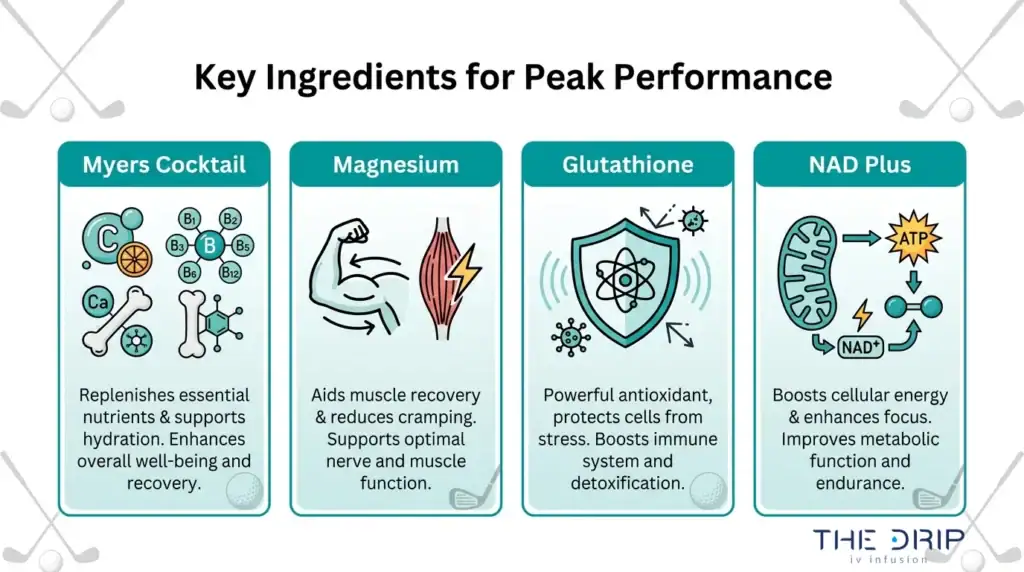
The IV drip ingredients that matter most for golfers include the Myers’ Cocktail, magnesium, glutathione, and NAD+. Each targets a specific performance or recovery need on the course.
Why Is a Myers’ Cocktail Popular Among Scottsdale Golfers?
A Myers’ Cocktail is popular among Scottsdale golfers because it combines magnesium, calcium, B vitamins, and vitamin C in a single infusion that addresses multiple demands of desert golf. This blend supports hydration, energy production, and muscle function simultaneously, making it a practical all-in-one option before or after a round.
A pilot study published in The Journal of Alternative and Complementary Medicine found that Myers’ Cocktail participants experienced significantly improved pain, tender points, depression, and quality of life at 8 weeks (p ≤ 0.02), with effects persisting 4 weeks post-intervention. For golfers dealing with soreness from repetitive swings or fatigue from heat exposure, this broad-spectrum formulation delivers meaningful support without requiring multiple separate add-ons.
How Does Magnesium Support Swing Mechanics and Muscle Function?
Magnesium supports swing mechanics and muscle function by regulating muscle contraction and relaxation cycles critical to a consistent golf swing. This mineral facilitates the release of calcium from muscle fibers after each contraction, preventing the sustained tension that leads to cramping and stiffness.
During a four-to-five-hour round in Scottsdale’s heat, golfers lose magnesium through sweat at accelerated rates. When levels drop, grip pressure becomes inconsistent, rotational power decreases, and involuntary muscle spasms can disrupt tempo at the worst moments. IV magnesium bypasses the slow absorption and gastrointestinal side effects common with oral supplements, restoring intracellular levels more efficiently. For golfers who rely on repeatable mechanics, maintaining adequate magnesium is one of the simplest ways to protect swing consistency through the back nine.
Why Do Golfers Add Glutathione for Sun and Oxidative Stress?
Golfers add glutathione for sun and oxidative stress because prolonged UV exposure during 18 holes generates free radicals that accelerate cellular damage and fatigue. Glutathione is the body’s most abundant endogenous antioxidant, and it neutralizes reactive oxygen species produced by both exercise and solar radiation.
According to a 2024 study in the Journal of the European Academy of Dermatology and Venereology, glutathione amino acid precursors demonstrated protective effects against UVB irradiation in skin models, reducing melanin content and DNA damage. For golfers spending four or more hours under direct Scottsdale sun, supplementing glutathione intravenously helps counteract the oxidative burden that compounds round after round. This makes it a particularly valuable add-on during multi-day golf trips.
How Does NAD+ Help Golfers With Endurance and Mental Clarity?
NAD+ helps golfers with endurance and mental clarity by supporting cellular energy metabolism and neurological function. This coenzyme plays a central role in converting nutrients into ATP, the primary energy currency cells use during sustained physical and cognitive effort.
However, golfers should set realistic expectations. According to a 2022 review in Sports Medicine, current evidence suggests that NAD+ therapeutics do not alter skeletal muscle metabolism or improve athletic performance in healthy humans. The potential benefits for golfers may lie more in cognitive sharpness and post-round recovery than in direct physical performance gains. Many golfers in Scottsdale report subjective improvements in focus and reduced mental fog, which matters on a course where shot selection and concentration often separate a good round from a great one.
With the right ingredient blend selected, the next consideration is how mobile delivery fits into a Scottsdale golf trip.
Why Is Mobile IV Delivery Ideal for Golfers Visiting Scottsdale?
Mobile IV delivery is ideal for golfers visiting Scottsdale because it eliminates travel to a clinic, fits around tee times, and serves entire groups in one location. The sections below cover how hotel-room service integrates into a golf trip and why tournament groups book mobile infusions.
How Does Hotel-Room IV Service Fit a Golf Trip Itinerary?
Hotel-room IV service fits a golf trip itinerary by bringing hydration and nutrient infusions directly to a golfer’s accommodation, removing the need to locate a clinic in an unfamiliar city. A typical session takes about an hour, making it easy to schedule the evening before an early tee time or immediately after a round. Golfers can relax, review their scorecard, or socialize while receiving treatment. For visiting players juggling resort dining, course reservations, and sightseeing, this on-site convenience means no itinerary disruptions. The flexibility to book a session at a hotel, rental home, or even a resort pool deck keeps recovery seamlessly woven into the trip.
Why Do Golf Tournament Groups Book Mobile IV for Their Teams?
Golf tournament groups book mobile IV for their teams because a single provider can treat multiple players in one location during the same visit. This group-friendly format reduces per-person scheduling hassle and keeps the entire roster on a consistent hydration protocol. For optimal pre-competition benefits, IV therapy should be scheduled 24 to 48 hours before the event to prime plasma volume and replenish nutrient stores, according to Mobile IV Medics. Coordinating a group session at the team hotel the night before a tournament round ensures every player arrives at the first tee equally prepared. For competitive buddy trips or corporate outings, shared mobile IV sessions also build camaraderie while addressing the practical challenge of keeping everyone performing well in desert heat.
With mobile delivery logistics covered, the next step is understanding how IV therapy stacks up against other hydration strategies.
How Does Mobile IV Therapy Compare to Other Hydration Methods?
Mobile IV therapy compares to other hydration methods by offering faster fluid absorption, bypassing the digestive system entirely. The key differences emerge when measuring IV drips against oral electrolyte drinks and urgent care visits.
How Do IV Drips Compare to Oral Electrolyte Drinks for Golfers?
IV drips compare to oral electrolyte drinks for golfers by delivering fluids and electrolytes directly into the bloodstream, achieving near-complete absorption. Oral drinks must pass through the gastrointestinal tract, where absorption is slower and less efficient, particularly when heat suppresses gut function during a round.
Key differences include:
- Absorption speed: IV fluids reach circulation within minutes; oral solutions require 30 to 60 minutes for partial absorption.
- Nutrient delivery: IV drips infuse electrolytes, B vitamins, and magnesium simultaneously in precise doses.
- GI tolerance: Oral drinks can cause bloating or nausea mid-round, while IV delivery bypasses the stomach entirely.
- Customization: IV formulas can be tailored with add-ons like glutathione or vitamin C based on individual needs.
For most golfers in Scottsdale’s extreme heat, oral electrolyte drinks work well as ongoing course hydration. However, they often fall short as a standalone strategy when sodium losses through sweat range from 230 to 2,070 mg/L depending on individual physiology and exercise intensity, according to a review published in Sports Medicine. Pairing oral hydration during play with a pre-round or post-round IV session covers both sustained sipping and deep-tissue replenishment.
How Does IV Therapy Compare to Visiting an Urgent Care for Heat Issues?
IV therapy compares to visiting an urgent care for heat issues by providing proactive, preventive hydration rather than reactive emergency treatment. Urgent care addresses heat exhaustion after symptoms escalate; mobile IV therapy aims to prevent reaching that point.
- Timing: Mobile IV sessions are scheduled before or after a round, while urgent care visits happen only after symptoms become severe.
- Setting: A mobile IV nurse arrives at a hotel room, rental home, or clubhouse. Urgent care requires leaving the course and sitting in a waiting room.
- Cost and time: A typical urgent care visit for heat-related complaints involves triage, evaluation, and potentially hours of waiting, often at a higher out-of-pocket cost than a planned IV session.
- Scope: Urgent care treats acute medical emergencies and is essential for true heat stroke. Mobile IV therapy is a wellness service focused on optimization and recovery.
Golfers should never substitute IV therapy for emergency medical care when experiencing confusion, loss of consciousness, or core body temperature above 104°F. For everything short of a medical emergency, proactive mobile IV hydration keeps golfers out of the clinic and on the course, making it a smarter approach to Scottsdale’s relentless desert heat.
Who Should Consider Mobile IV Therapy Before Playing Golf?
Mobile IV therapy before playing golf benefits senior golfers, multi-day tournament participants, and recreational players alike. Each group faces distinct hydration and performance challenges on Scottsdale courses.
Is IV Therapy Beneficial for Senior Golfers in Scottsdale?
IV therapy is beneficial for senior golfers in Scottsdale because aging reduces the body’s ability to regulate temperature and retain fluids. Older adults experience diminished thirst signals, making self-hydration unreliable during a four-to-five-hour round in desert heat. Scottsdale’s extreme temperatures compound this risk considerably. A 2020 study published in Temperature found that perceived dehydration carried an adjusted odds ratio of 4.65 for exertional heat exhaustion symptoms among amateur golfers. Seniors who replenish electrolytes, B vitamins, and magnesium through IV infusion before teeing off can better sustain focus and muscle function. For golfers over 60, proactive hydration is not a luxury; it is a practical safeguard against heat-related decline on the course.
Should Golfers on Multi-Day Tournament Schedules Use IV Therapy?
Golfers on multi-day tournament schedules should use IV therapy because consecutive rounds in Scottsdale heat create cumulative fluid and nutrient deficits that oral hydration alone struggles to reverse overnight. Each round depletes electrolytes, B vitamins, and antioxidant stores. Without full recovery between rounds, shot accuracy and decision-making deteriorate progressively. Scheduling an IV session during rest periods between rounds helps restore plasma volume and replenish depleted nutrients more efficiently than drinking fluids alone. For tournament groups visiting Scottsdale, mobile delivery makes this especially practical; a session fits seamlessly into an evening hotel recovery routine without disrupting the next day’s tee time.
Do Recreational Golfers Benefit or Is It Only for Competitive Players?
Recreational golfers benefit from mobile IV therapy, not just competitive players. Dehydration does not distinguish between skill levels. A 2012 study in the Journal of Strength and Conditioning Research found that mild dehydration reduced shot distance by 11% and increased off-target distance by 93% in golfers, regardless of competitive status. Weekend players spending four hours under Scottsdale’s sun face the same fluid loss, electrolyte depletion, and cognitive decline as touring professionals. Anyone who wants to finish 18 holes feeling strong, rather than sluggish, stands to gain from pre-round IV hydration. With mobile IV therapy bringing golfers of every level a practical edge, the next step is choosing a trusted Scottsdale provider.
How Can The Drip IV Infusion Elevate Your Scottsdale Golf Experience?
The Drip IV Infusion can elevate your Scottsdale golf experience by delivering mobile IV therapy directly to your hotel, rental home, or resort before or after your round. The following sections cover athletic performance drips and key takeaways for golfers.
Can The Drip IV Infusion’s Athletic Performance Drips Help Golfers Play Their Best?
Yes, The Drip IV Infusion’s athletic performance drips can help golfers play their best by targeting hydration, nutrient replenishment, and recovery. The Drip IV Infusion offers customizable IV cocktails with add-ons such as magnesium, B-complex vitamins, glutathione, and amino blends, all of which support the physical and cognitive demands of a desert round.
It is worth noting that not every ingredient carries the same level of clinical backing. According to a 2022 review in Sports Medicine, current evidence suggests that NAD+ therapeutics do not alter skeletal muscle metabolism or improve athletic performance in healthy humans. For golfers, the greatest value likely comes from rapid rehydration and electrolyte restoration rather than any single add-on ingredient. The Drip IV Infusion’s team of experienced nurses can help tailor each session to your specific needs, whether that means pre-round preparation or post-round recovery.
What Are the Key Takeaways About Why Mobile IV Therapy Is a Game Changer for Golfers in Scottsdale?
The key takeaways about why mobile IV therapy is a game changer for golfers in Scottsdale center on convenience, speed, and climate-specific benefits:
- Scottsdale’s desert heat accelerates fluid and electrolyte loss, making proactive hydration essential for maintaining focus, accuracy, and swing power across 18 holes.
- Mobile IV therapy eliminates the need to visit a clinic; a nurse comes to your location, keeping your golf trip schedule intact.
- A typical session takes approximately one hour, including setup and the infusion itself.
- Customizable drip formulas allow golfers to address individual needs, from rehydration and energy to muscle recovery and antioxidant support.
- Scheduling a session 24 to 48 hours before tee time gives the body time to optimize plasma volume and nutrient stores.
For visiting golfers navigating Scottsdale’s demanding conditions, mobile IV therapy bridges the gap between basic water intake and the level of preparation serious players need. The Drip IV Infusion brings this service directly to homes, hotels, and resorts across the Scottsdale area, backed by a team with decades of nursing and emergency medicine experience.